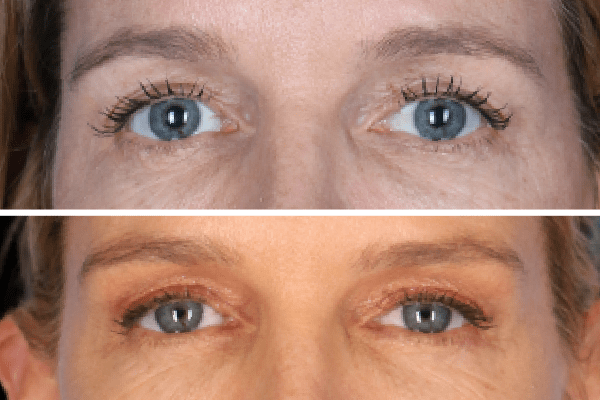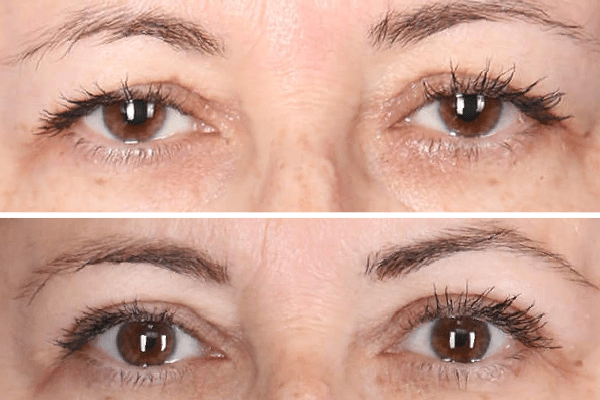
When someone looks in the mirror and feels the upper face appears tired, heavy, or older than they feel, it is natural to assume the eyelids are the cause. Sometimes that is true. In many cases, however, part of the heaviness comes from the brow above, and occasionally both areas contribute. Because a brow lift and an eyelid lift address different structures, choosing the right approach depends on careful examination rather than on which procedure sounds more familiar. At Privé Beverly Hills, Dr. Catherine Chang, MD, FACS, evaluates the brow, forehead, and eyelids together so that each patient understands what is creating the concern and which procedure, or combination, may address it.
The brow, forehead, and upper eyelids work as a connected unit. The brow sits above the bony orbital rim, and its position influences how much skin rests on the upper eyelid. When the brow descends with age, it can push skin downward and create hooding that resembles excess eyelid skin. At the same time, the eyelid skin itself can stretch, the supporting muscles can weaken, and fat around the eyes can become more prominent. Each of these changes has a different solution.
Because brow descent and eyelid changes can look similar, an accurate assessment determines whether a brow lift, an eyelid lift, or both would be most appropriate. Treating only the eyelids when the brow is the main contributor may produce a less satisfying result, and the reverse is also true. Dr. Chang’s training in cranio-maxillofacial surgery informs a detailed understanding of the bone structure and soft tissue relationships around the eyes.
Research has examined how eyelid surgery and brow position interact. In a 2023 systematic review and meta-analysis published in Aesthetic Plastic Surgery, Liu and colleagues found that brow height decreased significantly on average after upper eyelid surgeries, with the degree varying by technique. These are averaged findings across studies, but they highlight why the brow should be considered when planning eyelid surgery.
A brow lift, also called a forehead lift, raises the soft tissue of the brow and forehead to create a smoother, more rested appearance. According to our brow lift page, it can improve the appearance of the forehead, the brows, and the area around the eyes.
Signs that the brow may be contributing include sagging of the outer or central brow, deep frown lines between or above the eyebrows, a tired or stern expression even at rest, and eyebrows that sit close to the eyelids. In some people, heavy brows can also interfere with the upper field of vision. These signs are discussed during consultation to determine whether the brow is a primary contributor.
Dr. Chang performs brow lift surgery under IV twilight sedation, without general anesthesia. Through a small incision near the hairline, she lifts the brows and forehead and removes excess skin, smoothing the area and softening fine lines. The goal is a subtle elevation that preserves natural expression rather than a surprised or overdone look.
An eyelid lift, or blepharoplasty, removes excess skin and fat from the eyelids to address drooping and puffiness. Our eyelid lift page explains that as eyelid skin stretches and supporting muscles weaken, sagging lids and under-eye bags can develop.
Upper blepharoplasty addresses excess skin that folds over the natural crease and can make the eyes appear heavy. Lower blepharoplasty addresses under-eye bags and puffiness related to protruding fat. Incisions are placed within the natural creases of the eyelid, along the lash line, or inside the eyelid, where they tend to be inconspicuous. For some patients, blepharoplasty is functional as well as cosmetic, improving vision by removing skin that obstructs it.
Dr. Chang performs blepharoplasty as an outpatient procedure under IV twilight sedation, without general anesthesia, so patients return home the same day. Men considering eyelid surgery may also review our blepharoplasty for men page, which addresses considerations specific to male anatomy and aesthetic goals.
Sometimes a drooping lid reflects weakness of the muscle that raises the eyelid rather than excess skin alone, a condition called ptosis. In a 2024 study in Plastic and Reconstructive Surgery, Falcon Rodriguez and colleagues reviewed patients presenting for upper blepharoplasty and found that a meaningful portion also required ptosis correction, and that a brow lift was performed in many cases. Identifying all contributing factors before surgery helps ensure that the procedure matches the cause.
For some patients, both the brow and the eyelids contribute to upper-face heaviness. In those cases, a brow lift and eyelid lift may be performed together or staged, depending on anatomy, health, and goals. Combining procedures can address the upper face as a whole, but it also affects recovery. Dr. Chang explains the reasoning behind any recommendation so patients can make informed choices.
The upper face is part of a larger picture. Some patients considering brow or eyelid surgery are also thinking about the mid-face, jawline, or neck. In those situations, a facelift may be part of a broader discussion. Planning with the whole face in mind supports balanced, natural-looking results.
Conditions such as dry eye, thyroid eye disease, high blood pressure, bleeding tendencies, and certain medications can influence the safety and planning of eyelid and brow surgery. Prior eye surgery, including vision correction procedures, should also be shared. These factors are reviewed during consultation and may affect timing, technique, or whether surgery is advisable at all.
A productive consultation is a conversation in which your priorities guide the evaluation. Coming prepared with questions helps you understand the reasoning behind any recommendation and what each option involves.
It is helpful to ask which structures appear to be contributing to the heaviness you notice, and why. You might ask whether the brow sits lower than ideal for your anatomy, whether there is excess eyelid skin or fat, and whether the muscle that raises the eyelid is functioning normally. Looking at photographs from earlier years can also be useful, since they show how the brow and eyelids have changed over time and help separate natural features from age-related changes.
Ask what a brow lift alone, an eyelid lift alone, or a combined approach would be expected to change, and what each would not change. Ask how incisions are placed, where scars are likely to sit, and how the plan protects natural expression. If a combined procedure is suggested, it is reasonable to ask whether staging is possible and how that would affect recovery.
Share your work schedule, upcoming events, and exercise habits so that timing can be planned realistically. Ask when you can expect to return to screens, driving, makeup, and exercise, and what support you may need at home in the first days. Practical preparation helps recovery feel manageable.
Some people wonder whether nonsurgical treatments can address upper-face heaviness. Neuromodulators can soften frown lines and, in selected cases, create a modest change in brow shape, and skin treatments can improve texture around the eyes. Our injectable treatments page describes the nonsurgical options offered at Privé Beverly Hills. These treatments can be appropriate for mild concerns or as complements to surgery, but they do not remove excess eyelid skin or reposition a significantly descended brow. An honest discussion of what nonsurgical care can and cannot achieve helps patients choose with clear expectations.
Eyelid and brow anatomy varies widely across ancestries and individuals, including differences in eyelid crease height, the presence or absence of a crease, brow shape, and the fullness of the upper lid. A thoughtful plan respects these features rather than imposing a uniform ideal. Preserving the character of a person’s eyes is central to a natural result, and this is a priority in every consultation at Privé Beverly Hills.
Recovery depends on which procedure or combination is performed. Our eyelid lift page notes that after blepharoplasty, mild discomfort, tenderness, and warmth around the eyes are expected, and blurred vision can occur during the first day, particularly after lower eyelid surgery. Cold compresses help reduce swelling, and patients are advised to sleep with the head elevated, rest their eyes, and avoid rubbing them.
Swelling and bruising after eyelid surgery typically subside within one to two weeks, and many patients return to work and daily activities after about a week. Strenuous exercise is usually avoided for at least three weeks while swelling resolves. Final eyelid results continue to refine over months. Brow lift recovery follows a similar gradual course, with swelling settling over the first weeks.
Following postoperative instructions, attending follow-up visits, protecting the incisions from sun, and allowing time before judging the final result all support a smooth recovery. Individual healing varies, and the practice remains available for questions throughout.
Dr. Catherine Chang, MD, FACS, is a board-certified plastic and reconstructive surgeon educated at Columbia University, trained at the University of Pennsylvania, and fellowship-trained at Harvard Medical School and Massachusetts General Hospital. Her practice emphasizes a bespoke, anatomy-first approach and natural-looking results. Learn more on our about Dr. Chang page.
If your upper face looks heavier or more tired than you feel, an individualized evaluation can clarify whether the brow, the eyelids, or both are involved. Dr. Chang and our team at Privé Beverly Hills look forward to discussing your goals and options. Request a consultation to begin.