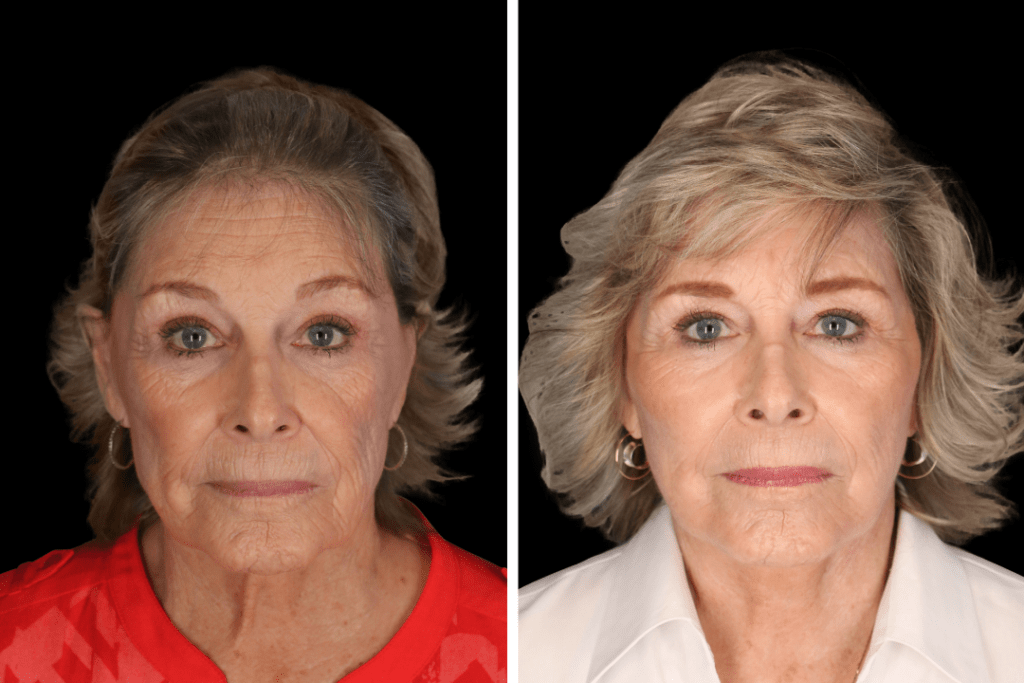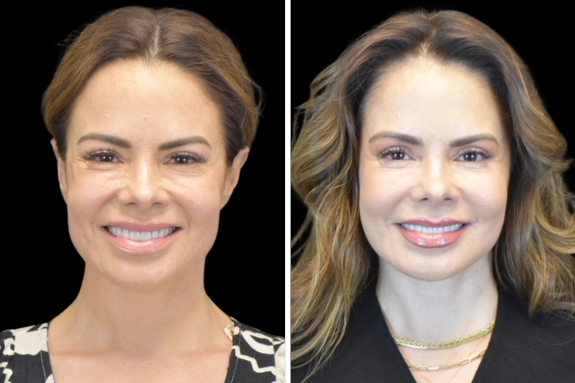

Many of the changes people associate with an older appearance are not caused by wrinkles or loose skin alone. A significant part of facial aging is the gradual loss of soft-tissue volume: the temples begin to hollow, the area beneath the eyes becomes more defined, the cheeks flatten, and the lips and chin lose some of their support. When volume diminishes, light falls on the face differently, shadows deepen, and features can look tired even when a person feels rested. At Privé Beverly Hills, Dr. Catherine Chang, a Harvard fellowship-trained, board-certified plastic and reconstructive surgeon, regards volume restoration as an essential part of natural-looking facial rejuvenation. Facial fat transfer, which uses a patient’s own tissue, is one of the most versatile ways our surgical team addresses this change.
Facial fat transfer, also called facial fat grafting or autologous fat transfer, is a procedure in which a small amount of fat is gently removed from one area of the body and carefully placed in areas of the face that have lost fullness. Because the material comes from the patient, the risk of an allergic reaction to a foreign substance is significantly reduced. The procedure at Privé Beverly Hills follows three steps: fat is harvested from a donor area with liposuction, then decanted, centrifuged, and processed, and finally the purified fat is reinjected into the facial areas that need improvement.
Fat grafting has become a central part of modern facial surgery because it addresses a problem that lifting alone cannot. In a 2023 article in Plastic and Reconstructive Surgery, Rodriguez-Unda, Novak, and Rohrich described fat atrophy as a hallmark of the aging process and noted that fat grafting has become a keystone of the modern facelift, with techniques refined through the selective use of different fat preparations in different regions of the face. In other words, restoring what has been lost is often as important as repositioning what has descended.
Beyond volume, transferred fat may also contribute to improvements in skin quality in some patients. Schiraldi and colleagues, writing in the Journal of Clinical Medicine in 2022, described autologous fat as an accessible and biocompatible soft-tissue filler that may offer both volume augmentation and skin quality improvement. These effects vary from person to person, and we discuss them as possibilities rather than guarantees.
Volume loss does not happen evenly. The face contains distinct fat compartments, and each tends to change at its own pace, which is why aging can look so different from one person to the next. One patient may notice hollowing at the temples and a more visible orbital rim, while another first sees a deepening groove between the lower eyelid and the cheek, or thinning around the mouth. These patterns are influenced by genetics, bone structure, weight history, sun exposure, and ethnic background.
Common areas for facial fat transfer include the temples, the under-eye hollows and tear troughs, the cheeks and mid-face, the nasolabial folds, the lips and perioral area, the chin, and the jawline. In each region, the objective is not to add as much volume as possible but to restore contour and smooth the transitions between features. For instance, a small amount of fat along the lid-cheek junction may soften the shadow that makes the eyes look fatigued, while subtle support at the temples can restore a more continuous line from the brow to the cheek.
Patients who come to us for fat transfer often describe a face that looks thinner or more drawn than they feel it should. Some have experienced significant weight loss, whether through lifestyle changes or medical treatment, and notice that the face has lost fullness faster than the body. Others have used dermal fillers for years and are interested in a longer-lasting approach using their own tissue. Many are concerned about looking overfilled, and that concern is entirely reasonable. Our approach is to restore what age has taken rather than to create volume that was never part of a patient’s natural structure.
Our Signature approach to facial fat transfer is guided by Dr. Chang’s belief that beauty is subjective and shaped by each person’s anatomy, genetics, skin type, and ethnic and cultural heritage. Before any treatment, Dr. Chang and our surgical team study the face in detail, often with reference to older photographs that show how the patient’s features looked at an earlier age. This allows us to identify which areas have genuinely lost volume, rather than applying a uniform pattern to every face.
The donor fat is typically taken from an area such as the abdomen, flanks, or thighs through a small incision of about 5 millimeters, using a thin cannula and a tumescent solution to loosen the fat gently. Because the harvest is performed with liposuction, some patients appreciate a modest refinement of the donor area, although the amount removed for facial grafting is small. Patients interested in more substantial body contouring can discuss liposuction as a separate consideration. The harvested fat is then processed and purified so that only healthy fat cells are prepared for placement.
The fat is placed through very small entry points using fine cannulas, in tiny amounts and at multiple depths. This layered technique is intended to give each small parcel of fat the best opportunity to establish a blood supply and integrate with the surrounding tissue. Dr. Chang typically performs facial fat grafting under general anesthesia, which allows for careful, unhurried work across multiple facial regions in a single session.
Fat transfer is frequently combined with other treatments for a more complete result. When the skin and deeper tissues have descended, a facelift or neck lift repositions the tissues, and fat grafting restores the fullness a lift cannot provide. Patients with heaviness or hollowness around the eyes may benefit from pairing fat transfer with an eyelid lift. For skin texture, fine lines, and pigmentation, CO2 laser resurfacing may be considered as a complementary step. For patients who prefer a non-surgical starting point or want to preview the effect of added volume, injectable treatments remain an option we discuss openly.
Good candidates for facial fat transfer are in good physical and mental health, do not smoke, understand the risks of a surgical procedure, and have realistic expectations about the outcome. Patients also need enough donor fat for harvest, which is rarely a limiting factor but is assessed during the consultation. Patients who are pregnant or breastfeeding are not candidates for this procedure. Those with conditions that affect healing or blood flow, or who take medications that increase bleeding risk, require careful evaluation, and in some cases a different approach may be recommended. Because weight changes can affect grafted fat, patients are generally advised to be at a stable weight before treatment.
After facial fat transfer, some redness, discomfort, and swelling are expected, and bruising may appear at the treatment and donor sites. The face often looks fuller in the early days because of swelling, which gradually subsides. Most of Dr. Chang’s patients plan to take at least 5 to 10 days away from work and social activities, and initial healing generally takes 1 to 2 weeks. After that, residual swelling continues to resolve before the final result becomes apparent.
An important part of informed decision-making is understanding that not all transferred fat survives. The fat that establishes a blood supply is expected to remain, and it continues to age with the patient much like the surrounding tissue. In a 2021 systematic review and meta-analysis in Aesthetic Plastic Surgery, Lv and colleagues analyzed 27 studies involving 1,011 patients and found that volume retention after facial fat grafting varied from 26 to 83 percent, with a pooled retention rate of 47 percent. The authors emphasized that the exact percentage retained is not yet predictable. For this reason, our surgical team plans placement with the expectation that some volume will be absorbed, and a small number of patients may choose a second session to refine the result.
Like any surgical procedure, fat transfer carries risks. The Schiraldi systematic review identified adverse events that included prolonged swelling, contour irregularities, asymmetry, graft overgrowth, fat necrosis, and, less commonly, intravascular injection, which is among the most serious concerns in facial grafting. Careful technique, appropriate cannula selection, and a thorough knowledge of facial anatomy are central to reducing these risks, and Dr. Chang’s specialized training in cranio-maxillofacial surgery informs how she approaches each region of the face. The goal is a softer, more rested appearance that looks like a natural version of you, which reflects our practice’s philosophy: results so natural, it will be your best kept secret.
Dr. Catherine S. Chang, MD, FACS, earned her medical degree at Columbia University College of Physicians and Surgeons, completed her combined general and plastic surgery training at the University of Pennsylvania, where she served as chief resident, and pursued fellowship training in cranio-maxillofacial aesthetic and reconstructive surgery at Harvard Medical School and Massachusetts General Hospital. She also taught surgical residents and medical students as a clinical instructor of surgery at Harvard Medical School. Dr. Chang has been recognized among Newsweek’s America’s Top Plastic Surgeons in 2021, 2023, 2024, and 2025.
Patients often tell us they value Dr. Chang’s candor as much as her technique. She will not suggest a procedure she does not believe is aligned with a patient’s goals, and she aims to reach those goals in the safest and most minimal way possible. Her NakedBeauty philosophy reflects a simple aim: helping patients feel confident in their own features without relying on makeup, filters, or editing. Prospective patients can review selected results in our before and after gallery.
If you have noticed that your face looks more hollow, drawn, or tired than you feel, facial fat transfer may be worth exploring as part of a thoughtful, individualized plan. Dr. Catherine Chang and our surgical team welcome patients from Beverly Hills, across LA, and from out of town to our office at 9300 Wilshire Boulevard, Suite 500. During your consultation, we will assess where volume has changed, explain whether fat transfer alone or a combined approach may suit you, and answer your questions about recovery and longevity. To begin, please contact Privé Beverly Hills to request a private consultation.